
The 43.43 metre tall rocket lifted off at 5.28 pm from the second launch pad at the Satish Dhawan Space Centre in Sriharikota

'Today, when we talk of success of PSLV and GSLV Mk III, we owe it to important inputs that the Prof. Narasimha committee gave'
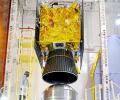
India successfully launched IRNSS 1C on board ISRO's PSLV C26 rocket from the spaceport at 1.32 am on Thursday, moving a step closer to setting up the country's own navigation system on par with Global Positioning System of the US.
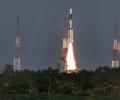
The satellite will enable a full range of services to neighbours including the areas of telecommunication, television, direct-to-home, VSATs, tele-education and tele-medicine.

ISRO Chairman K Sivan described the GSAT-11 as the "richest space asset" for India.

And the first Indian to go into space from 'Indian soil' could well be a woman.

The engine is earmarked for the LVM3-M3 mission identified for launching the next 36 OneWeb India-1 satellites, the Indian Space Research Organisation said.

'With India's growing capabilities in the space sector, this creates promising opportunities for enhanced collaboration and market access.'

It is important for India to develop multiple launch sites and become capable of undertaking more launches in a year's time, says Ajey Lele.

Indian Space Research Organisation's second mission of the year to place an earth observation satellite by a GSLV rocket faced a setback as the mission could not be accomplished fully due to performance anomaly in the cryogenic stage of the rocket, the space agency said on Thursday.

In a landmark late Monday night journey into a new era of space application, India successfully launched its first dedicated navigation satellite using the Polar Satellite Launch Vehicle which blasted off from the Satish Dhawan Space Centre.

A high power satellite, GSAT-15 is being inducted into the INSAT/GSAT system. GSAT-15 carries a total of 24 communication transponders in Ku-band as well as a GPS-Aided GEO Augmented Navigation (GAGAN) payload operating in L1 and L5 bands.

India's heaviest rocket ever is expected to take to the sky next January on an experimental flight whose later versions could be used to send humans on space missions.

"I am extremely happy to announce that GSLV Mark III successfully injected Chandrayaan 2 in the defined orbit, infact the orbit is 6,000 km more than what was intended," Sivan said.

The Indian government must support ISRO so that it is able to achieve its goal of becoming self-sufficient in all segments of the space business. The highly successful PSLV programme is a testimony to its capabilities. Now it needs to demonstrate the same with GSLV. Nothing should waver it from this goal. Not even competition with China, says Dinesh C Sharma

GSAT-18, which aims at providing telecommunications services for the country by strengthening ISRO's current fleet of 14 operational telecom satellites, was launched into a Geosynchronous Transfer Orbit about 32 minutes after the lift-off.
The flight took off from Sriharikota in the Bay of Bengal on schedule.

The ISRO on Sunday scripted yet another history after its LVM3 rocket successfully placed 36 satellites of United Kingdom-based OneWeb group company into intended orbits.
The Mars mission should not have been a priority at this stage for India which, instead, ought to have devoted time and energy on getting its rocket operational again and give momentum to the human space flight programme, former ISRO chief G Madhavan Nair said.

ISRO needs next generation launchers and new facilities to manufacture and launch them.

The FAC found that the failure happened when the Geosynchronous Satellite Launch Vehicle rocket's cryogenic engine was to kick in to take the rocket forward.
India's top space scientists are analysing data to find out what caused the failure of Geosynchronous Satellite Launch Vehicle mission and an expert committee is likely to be formed soon to give a report on it.

The stage is set for the launch of India's satellite IRNSS-1D on Saturday from Sriharikota onboard workhorse PSLV-C27 that would pave the way for the country's own navigation system on par with the GPS of United States.
The satellite was placed at 4.18 pm, a little over 17 minutes after the Geosynchronous Satellite Launch Vehicle (GSLV-F-01) carrying it was launched from the Satish Dhawan Space Centre in Sriharikota.
The Indian Space Research Organisation on Thursday achieved a significant milestone in Mahendragiri, Tamil Nadu, when it successfully tested the indigenously developed Cryogenic Stage, to be employed as the upper stage of India's Geosynchronous Satellite Launch Vehicle.

The Indian Space Research Organisation successfully put India's heavy rocket Geosynchronous Satellite Launch Vehicle-Development 5 (GSLV-D5) into orbit from the spaceport at Sriharikota, Andhra Pradesh at 4.18 pm on Sunday.
It's time that we, as a nation, stopped fearing failure and waiting for instant success in our space ventures. Let us instead applaud the journey, even if it comes at a certain cost to the taxpayer.
K Narayana, former director of SDSC-SHAR and currently senior advisor to the Centre, will chair the 15-member panel

Weighing about 5,854 kg, GSAT-11 would play a vital role in providing broadband services across the country, and also provide a platform to demonstrate new generation applications.

K Sivan has to hasten the effort to bring in private players into satellite and rocket building and replicate India's software success in aerospace.
The apogee [farthest point] is 36,000km and the inclination of the orbit with respect to the equatorial plane has been reduced from 7.37 degrees to the present 0.32 degrees,

The ISRO is aiming for a soft landing of the lander in the South Pole region of the moon where no country has gone so far.
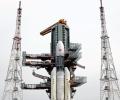
India's second mission to the moon will be launched on Monday at 2.43 pm after its initial launch on July 15 was called off owing to a "technical glitch."

India's heavy-lift rocket GSLV MkIII, carrying communication satellite GSAT-19.

The feat is the second one for the Indian Space Research Organisation scientists in using the indigenously made cryogenic stage after the January 5, 2014 launch of GSLV-D5.
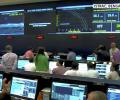
ISRO has said once the Lunar night falls, there would be no sunlight for the lander to generate power for its working and also it was not designed to operate in the heavy cold temperature of Moon during the phase.

Officials hint the visit could finally see a formal defence industrial road map being adopted by both nations.
The teething issues concerning the launch of Chandrayaan 2 -- the second lunar mission of the Indian Space Research Organisation -- have been cleared.

It also carries equipment for meteorological data relay and satellite based search and rescue services being provided by earlier INSAT satellites.
 © 2026 Rediff.com - Advertise with us - Disclaimer - Privacy Policy - Sitemap - Feedback - About us - Terms of use - Grievances